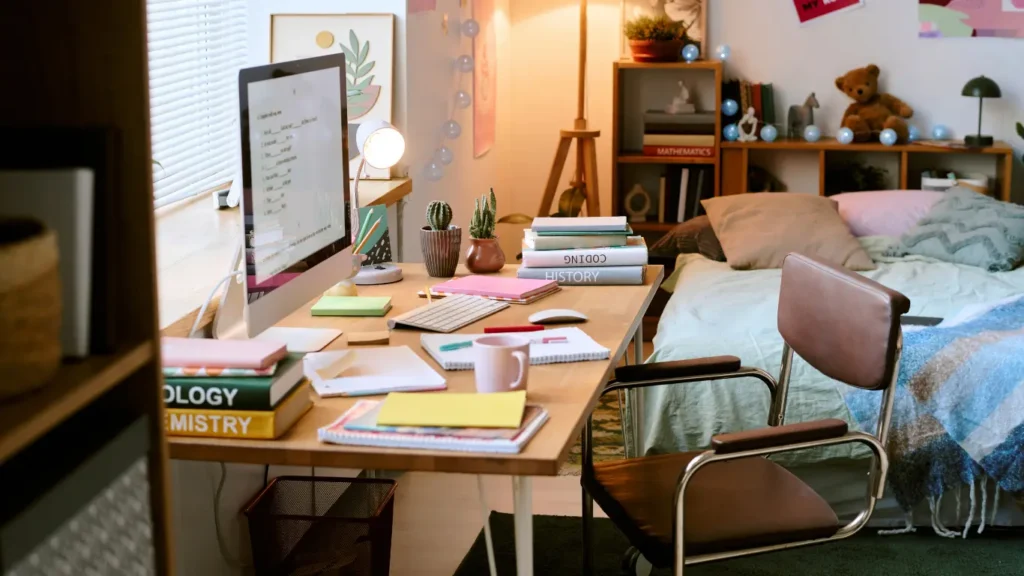
A productive study space does not need to look like a perfectly designed home office. You do not need an expensive desk, a large room or the latest technology to study effectively.
For many distance-learning students, the available study area may be a kitchen table, bedroom corner, shared room or temporary surface that must be cleared after every session. What matters is that the space helps you concentrate, access your material and work as comfortably as your circumstances allow.
Learning how to create a productive study space begins with the space and resources you already have.
What Makes a Study Space Productive?
A productive study space is an area where you can complete coursework with as few unnecessary interruptions as possible.
It should allow you to:
- Read and write comfortably
- Keep essential study material nearby
- See your work clearly
- Concentrate for a reasonable period
- Use any technology required by your course
- Store or pack away your work safely
The space does not have to remain set up throughout the day. A temporary area can still become an effective study space if you prepare it consistently.
Create a Productive Study Space With What You Have
Begin by looking for the most practical area in your home. Instead of searching for the perfect room, identify the place that offers the best available combination of light, seating and limited disruption.
Possible study areas include:
- A kitchen or dining-room table
- A small desk in a bedroom
- A quiet corner of a living area
- A cleared section of a counter
- An outdoor area during suitable weather
- A public library or community facility where available
- A workplace area during an approved break
The best option may change throughout the week. You might use a shared table in the evening and a quieter area over the weekend.
If your study space is temporary, keep your materials together in a box, bag or folder. This allows you to set up quickly and pack everything away without losing important notes.
Choose the Quietest Available Time
A quiet space is useful, but a quiet time can be just as important.
If your household is busy during the afternoon, consider studying earlier in the morning or later in the evening. Parents may use the time when children are at school, completing homework or asleep.
Speak to the people you live with about your study routine. Let them know which periods you have set aside and when an assessment deadline is approaching.
Complete silence may not be possible in a shared home. If noise remains distracting, simple earphones, earplugs or low background sound may help. Choose an option that does not prevent you from noticing important activity around you.
Make the Seating as Comfortable as Possible
You may not have access to an adjustable office chair, but you can still improve your seating position.
Use a chair that supports your back where possible. If the chair is too deep, place a folded blanket or cushion behind your lower back. Keep your study material at a height that does not require you to bend forward continuously.
If you study on a bed because no table is available, try to sit upright against a wall or headboard and use a firm surface under your notebook or device. Avoid lying down while studying, as this can make it harder to write and may encourage you to fall asleep.
Change position during longer sessions and take short breaks to stretch. Comfort supports concentration, but no single position should be maintained for several hours.
Use the Light Available to You
Good lighting makes it easier to read and can reduce unnecessary strain.
Natural light may be sufficient during the day. Position yourself so that light reaches the page or keyboard without reflecting directly from a screen.
For evening study, use the brightest safe light available. A movable lamp can help focus light on your work without requiring the entire room to be illuminated.
If electricity is unavailable, shift reading and writing tasks to daylight hours where possible. Rechargeable lighting may be helpful if it is affordable, but students should not feel that special equipment is required before they can begin studying.
Keep Only Essential Items Nearby
A cluttered surface can make it difficult to find material and may reduce the space available for writing.
Before starting, collect the items required for that particular session. These may include:
- A textbook or downloaded study guide
- A notebook
- Pens and a highlighter
- Assessment instructions
- A calculator
- A charged phone, tablet or laptop
- Water
You do not need to place every textbook and piece of stationery on the table at once. Keep the area focused on the task you are completing.
At the end of the session, return loose pages to the correct folder and record where you stopped. This will make your next session easier to begin.
Prepare for Printed and Digital Study Material
Distance-learning courses may provide printed textbooks, digital documents or a combination of both. Your study space should support the format used by your course.
For printed material, keep books dry and store loose pages in labelled folders. Use page markers to identify important sections instead of folding or damaging pages.
For digital material, create folders for each subject or module. Download documents in advance so that you can continue studying without a permanent internet connection.
If you share a device with someone else, agree on the times when you need it. Save your work carefully and keep a backup on a memory stick, another device or cloud storage when connectivity is available.
A smartphone can be used to read material or communicate with the college, but a small screen may not be comfortable for longer assessments. Use printed documents or a larger device when one becomes available.
Reduce Digital Distractions
A phone or computer may be necessary for your course, but it can also become a source of distraction.
Before a study session:
- Silence unnecessary notifications.
- Close applications unrelated to your coursework.
- Download the files you need.
- Place your phone out of reach if it is not required.
- Decide what you want to complete before going online.
If you use mobile data, working offline can help you manage both distractions and data costs. Download your study material, switch off the connection and reconnect when you need to send a question or submit work.
Add Simple Study Cues
A study cue is a small action that signals that it is time to concentrate. This can be useful when the same space is used for meals, family activities and coursework.
Your cue could be:
- Placing a particular notebook on the table
- Putting your phone on silent
- Filling a bottle of water
- Writing the session’s goal at the top of a page
- Setting a timer
- Opening the relevant module
Repeating the same short routine can help you move into study mode without spending too much time preparing.
Avoid turning setup into a lengthy activity. The purpose is to begin studying, not to keep reorganising the space.
Keep Your Study Goal Visible
Before each session, write down one clear task.
Instead of writing “study Financial Management,” use a specific goal such as:
Read the section on budgeting and summarise the main terms.
A Business Management student might review one management function. An Office Administration student could work through a document-control activity. A Project Management student may revise the stages of a project.
A clear goal prevents you from sitting at your study space without knowing where to start. It also gives you a finishing point.
What If You Cannot Study at Home?
Some homes may be too crowded, noisy or unpredictable for regular study. If this applies to you, consider safe alternatives available in your area.
A public library may provide seating, lighting and occasional internet access. Community centres, places of worship or other public facilities may have suitable spaces at certain times. Ask about their rules and opening hours before relying on them.
You could also speak to a trusted family member about studying at their home for a few hours each week. If your workplace has an appropriate area, ask for permission to use it during lunch or before your shift.
Do not assume that a public space will provide everything you need. Take your study material, stationery and charged device with you, and keep personal belongings secure.
Review What Is and Is Not Working
Use your study space for a week and then consider what needs to change.
Ask yourself:
- Can I concentrate here?
- Is the lighting sufficient?
- Do I experience discomfort?
- Which distractions occur most often?
- Can I find my material easily?
- Does the space support printed and digital work?
- Would a different time of day work better?
Small changes can make a meaningful difference. You might move the chair, prepare material earlier or change the time of your study session.
Productivity does not depend on making the space attractive. It depends on making it usable.
Choose a Study Method That Fits Your Circumstances
Skills Academy, Bellview Institute of Distance Learning and Matric College offer courses that can be completed through distance learning. Depending on the course, students may use printed material, digital resources or both.
Before enrolling, ask how the course material is supplied, how assessments are submitted and what type of internet access is required.
This is especially important if you share a device, rely on mobile data or have limited connectivity. Choosing a course that suits your available resources can make your study routine more manageable.
Start With One Practical Improvement
You do not need to buy new furniture or redecorate a room to create a productive study space. Begin with one practical improvement.
Clear a surface, gather your material into one container and choose a regular study period. Improve the lighting or adjust your seating with items already available at home.
The best study space is not necessarily the largest, quietest or most expensive. It is the space that allows you to begin your work, protect your materials and make consistent progress with what you have.